HomeServicesProcess Guide45-Foot OvenFAQGalleryContact
How Powder Coating Works

The Complete 4-Step Powder Coating Process Explained

Powder coating is more than just "spray paint for metal." It's an engineered finishing process involving chemistry, electricity, heat, and precision timing. This guide walks through every step—from your initial consultation through final curing.

Zero-Defect Inspection45-Foot Industrial Oven10-15 Year Durability

Why The Process Matters

Many manufacturers view powder coating as a commodity service: drop off part, pick up finished part, move on. But the quality of your finish—durability, appearance, corrosion resistance—depends entirely on process execution.

A coater cutting corners on pre-treatment might save $50 on your project today. But adhesion failure or premature corrosion will cost you $500 in rework later. Patriot's approach: full process transparency, from first touch to final delivery.

4Precision Steps
350-450°FCure Temperature
98%Powder Reused
10-15 YrsTypical Durability
Consultation meeting reviewing powder coating project blueprints01
Step One

Consultation & Specification Review

30-60 Minutes

The first step isn't coating—it's understanding. This consultation phase prevents misalignment and ensures we coat exactly what you're expecting. See common questions about our process →
PART ASSESSMENT
  • Dimensional verification for oven fit
  • Material identification (steel, aluminum, stainless)
  • Condition evaluation & special considerations
SPECIFICATION DEFINITION
  • Coating system: epoxy, polyester, marine-grade
  • Color, gloss/matte finish, custom match
  • AAMA, mil-spec, or custom compliance
PRE-TREATMENT STRATEGY
  • Existing coating/contamination removal plan
  • Wash, media blast, or heavy stripping
  • Phosphate or chromate pre-treatment path
TIMELINE & COST
  • Realistic turnaround based on capacity
  • Transparent pricing before commitment
  • Delivery & pickup coordination
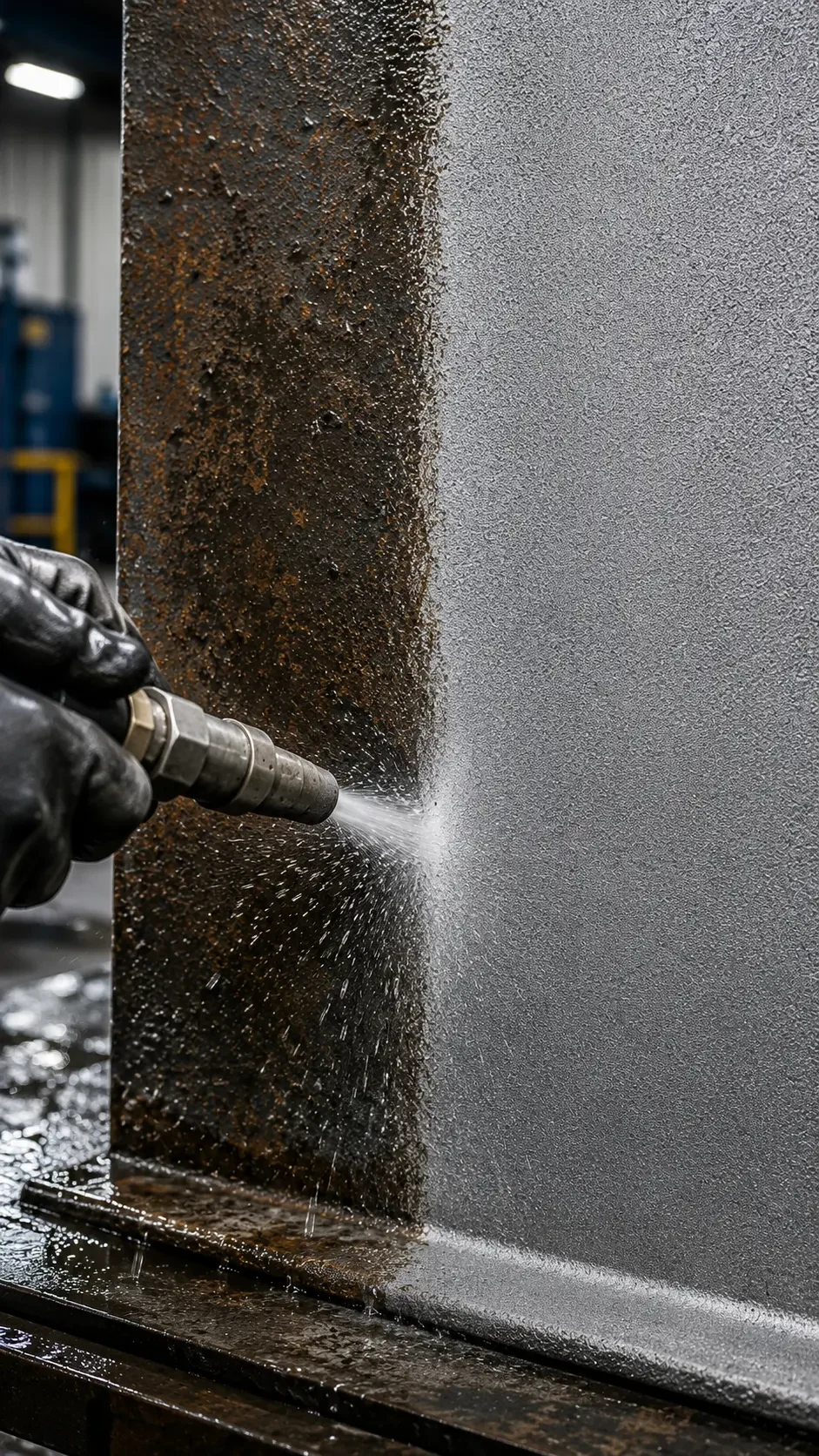
Technician sandblasting a structural steel beam for surface preparation02
Step Two

Pre-Treatment & Surface Preparation

6-12 Hours

If consultation is the planning phase, pre-treatment is the foundation. Powder coating only bonds as well as the surface it's applied to. Skipped pre-treatment = coating failure. Period. This is why we emphasize it in our quality commitment →

PHASE 1 · CLEANING & DEGREASING
  • High-pressure industrial washdown
  • Removes oils, grease, atmospheric grime
  • 2-4 hours depending on contamination
PHASE 2 · SURFACE PREPARATION
  • Media blasting or chemical stripping
  • Bare metal with adhesion-ready texture
  • 4-8 hours depending on condition
PHASE 3 · CHEMICAL PRE-TREATMENT
  • Zinc/iron phosphate conversion coating
  • Chromate system for marine-grade jobs
  • Deionized rinse, 2-5 minute reaction
PHASE 4 · FINAL DRYING
  • Heated chamber, 120-150°F
  • 15-30 minutes, zero moisture target
  • Moisture-meter verified before coating

Why it matters: Moisture or oil residue prevents powder from bonding. A clean, textured, dry surface is the difference between a 15-year finish and premature failure.

Freshly powder coated white metal railing ready for curing03
Step Three

Electrostatic Powder Application

5-15 Minutes

Now the coating actually happens. Your part, still warm from drying, enters our application booth where charged powder particles are electrostatically applied to create the finished color. Learn more about application →

Powder coating uses electricity to attract powder to metal: finely charged particles are drawn to the grounded part, wrapping completely around corners, edges, and tight geometries—coverage liquid paint simply can't match.

  1. Part positioned on conveyor for optimal access
  2. Correct powder type loaded into electrostatic gun
  3. Charged particles applied for complete, even coverage
  4. Complex geometry gets 2-3 passes if needed
  5. Loose powder gently removed before curing
FILM BUILD TARGET
  • 1.5-3.0 mils (0.0015-0.003 in)
  • Too thin: weak protection, color variance
  • Verified with Elcometer gauge, every job
THE ADVANTAGE
  • Powder wraps corners; paint drips & runs
  • 98% overspray recaptured and reused
  • Zero VOC emissions during application
Interior of an industrial curing oven tunnel with conveyor rail04
Step Four

Curing & Heat Setting

45-60 Minute Cycle

Powder coating alone isn't hard—it's just fine particles on your part. Curing is where the magic happens: heat causes cross-linking that bonds particles into a hard, durable finish. Our 45-foot industrial oven → delivers precision temperature control every time.

TEMPERATURE & TIME
  • 350-450°F target (powder-specific)
  • 10-30 minute dwell time at temperature
  • Gradual ramp-up and cool-down cycle
THE CHEMISTRY
  • Melt phase: particles flow across surface
  • Cross-linking builds a polymer network
  • Cools into one solid, void-free coating
Won't peel or chip — chemically bonded
Harder than liquid paint (ASTM D3363)
Blocks moisture & oxygen corrosion
Resists oils, solvents, salt, UV rays

Patriot's oven advantage:±5°F variance, uniform air circulation, and 45-foot oversized capacity mean no cold spots and no premature failure — even on the largest projects.

Step Five

Quality Verification: Zero-Defect Results

Curing doesn't end the process—it's where quality verification begins. Every Patriot project undergoes final inspection before shipping.

Visual Inspection

Color accuracy matches approved sample
Gloss/matte finish uniform across part
No drips, runs, sags, or skins
No thin spots or coverage gaps
No dust specks or defects
Edges and corners fully coated
ADHESION TESTING · ASTM D3359
  • Cross-hatch blade cuts a grid into the coating
  • Measures % of coating remaining bonded
  • Pass criterion: ≥95% adhesion (5B rating)
HARDNESS TESTING · PENCIL METHOD
  • Graded pencil (H, HB, F) rubbed across coating
  • Rating indicates scratch resistance
  • Patriot typically achieves HB-F on industrial jobs

Powder Coating vs. Liquid Paint: The Real Difference

FactorLiquid PaintPowder CoatingWinner
Durability3-5 years10-15 years Powder
Corrosion ResistanceModerateExcellent Powder
Coverage UniformityUneven (drips)Perfect Powder
Environmental ImpactHigh VOCZero VOC Powder
Waste Recapture0% (waste)98% (reused) Powder
5-Year Total CostLower upfront, higher maintenanceHigher upfront, lower total cost Powder

Bottom line: Powder coating costs slightly more initially but saves 40-60% on total lifecycle cost due to superior durability.

Close-up of a finished black powder coated wrought iron gateFactory line workers performing final quality checks

After Delivery: Care & Maintenance

Your finished part is durable—but to maximize lifespan, follow these guidelines:

Installation & Use

Handle with clean gloves — oils can mark finish
Don't drag on concrete, it will scratch coating
Install per engineering specs
Use as designed for rated performance

Maintenance

Clean annually with mild soap and water
Dry completely after cleaning
Avoid harsh chemicals unless coating is rated
Rinse with fresh water after saltwater exposure

Expected Lifespan

10-15 YrsStandard Epoxy
15-20+ YrsMarine-Grade Coating
15-20 YrsAAMA Architectural

Key Takeaway:From consultation through final delivery, powder coating is a precision process combining chemistry, electricity, heat, and meticulous quality control. This is why Patriot's process-focused approach delivers superior results. See why our 45-foot oven makes a difference →

Related Resources

Ready to See Your Part Coated?

Bring your part, specifications, or just questions. We'll walk you through exactly what will happen to your part—from first touch through final delivery.

Call (786) 391-0645→ Patriot team answers within 2 hours (yes, Saturdays too)